Module 3 · Lesson 3 of 3
The Appeals Process
When a prior authorization or claim is denied, the story isn’t over. Learn how to file an appeal and increase your odds of approval.
When a prior authorization or claim is denied, the story isn’t over. Learn how to file an appeal and increase your odds of approval.
James just got the denial letter. “Not covered. Appeal within 180 days.” His stomach sank. He was thinking: this is it, they won. But here’s what I need to tell James—and tell you: that denial is not final. It’s a starting point. You have a legal right to ask them to reconsider — not once, but up to three times if you need to. Most patients don’t appeal because they don’t know how or think it won’t work. But James is about to learn both. So are you.
When your plan denies you, you get a formal notice that says why. It might say “not medically necessary,” “does not meet plan criteria,” or “insufficient clinical evidence.” That reason matters, because your appeal will address exactly that.
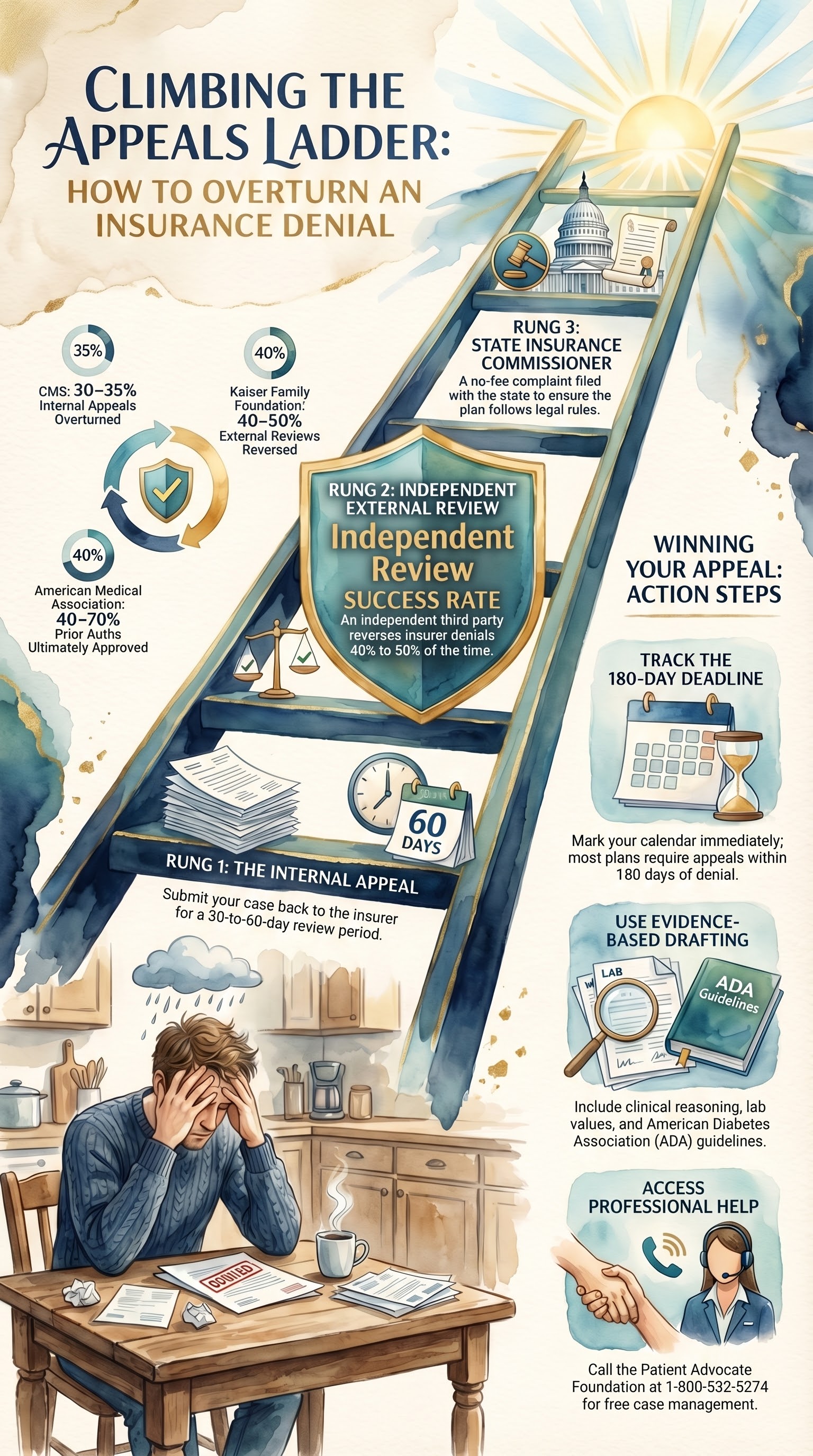
There are three levels of appeal. Think of them as climbing stairs.
You send your appeal back to the plan itself. They have 30 days to respond if the service hasn’t happened yet, or 60 days if you’ve already had the service. If it’s urgent — meaning waiting would seriously harm your health — you can ask for an expedited internal appeal. They have 72 hours to respond.
If the plan denies your internal appeal, or if you don’t trust their answer, you can request an external review. An independent reviewer (not employed by your plan) looks at the case fresh. This takes 45 days for standard reviews, or 72 hours if it’s urgent. Here’s the key: external reviewers overturn denials more often than the plan does. About 40–50% of external reviews reverse the plan’s decision.
If you lose at external review, or if you believe the plan broke the rules (didn’t respond on time, didn’t consider your evidence, etc.), you can file a complaint with your state’s insurance department. It costs nothing. The state can compel the plan to follow the law.
Most people succeed at Level 1 or Level 2. You won’t need Level 3.
How often do appeals work? Studies show that about 30–35% of internal appeals succeed — the plan reverses or partially reverses the denial. External review? 40–50% of those are successful. The American Medical Association found that 40–70% of appealed prior authorizations are ultimately approved.
Why? Because when you appeal, you’re adding something new: evidence. And that evidence often matters. Most denials come from the plan’s automated process or a reviewer who didn’t have the full picture. Your appeal gives them the full picture.
The most common reasons for denial are:
Those are all things you can answer in an appeal. You can provide the evidence. You can document what you’ve already tried. You can cite the guidelines that support why you need this.
So appeals are not a long shot. They are a legitimate process where about one-third to one-half of patients succeed. You’re not fighting — you’re presenting your case.
Here’s what you do this week. You’re filing your Level 1 internal appeal. Use this checklist:
If you lose your internal appeal, your next step is external review — a 45-day process where an independent reviewer looks at the case. You’ll file the same evidence you submitted to the plan.
Do this now. Open your phone calendar. Find the deadline on your denial letter. Set a reminder for 2 minutes before the deadline — that’s 179 days from the date you got the letter. Add a note: “File appeal. Send to [address on denial].” Why 2 minutes before? Because once you send your appeal, you’re protected. You don’t want to miss the deadline by one day.
That’s it. That one action protects your right to appeal. Next step is gathering evidence. But first, James (and you) need the deadline locked in.
If you’re unsure how to write your letter or gather evidence, free help is one phone call away:
An appeal is not a fight. It is a formal, legal process where you get to present your case a second time — and a third time if needed. About one-third to one-half of people who appeal succeed. Your odds are better than you think.
Next lesson: Your appeal succeeded — or maybe it didn’t. Either way, you’re thinking ahead to next year. In Module 4, we talk about open enrollment: when to switch plans, what to look for, and how to use this year’s denials to make a smarter choice next year.
Step zero, tonight (2 minutes): open your denial letter, find the line that says “appeal within ___ days,” and put that deadline on your phone calendar with a reminder seven days before. Miss the deadline and the appeal door closes.
This week: file your Level 1 internal appeal. Use the five-step checklist above. If you get stuck, call SHIP (1–800–839–2675) or the Patient Advocate Foundation (1–800–532–5274) — they’re free, and they’ve helped thousands of people appeal denials.
The appeal deadline is 180 days from the denial date. Don’t wait.
1. HealthCare.gov — Internal Appeals Process and Timelines
“You have the right to appeal a health plan’s decision to deny coverage. Internal appeals must be filed within 180 days of receiving notice of denial. The plan must respond within 30 days for non-urgent care not yet received, 60 days for services already received, or 72 hours for urgent care.”
2. CMS — External Appeals and Independent Review
“If you disagree with your health plan’s internal appeal decision, you can request an external review by an independent reviewer. Standard external reviews are decided within 45 days; expedited external reviews within 72 hours. External reviewers are not employed by your health plan.”
3. U.S. Department of Labor — ERISA 29 CFR 2560.503-1
“Every employer health plan must establish reasonable procedures for filing benefit claims and appeals. Participants must be given at least 180 days from receipt of an adverse benefit determination to appeal. For urgent situations, the plan must notify participants orally and in writing of appeal decisions within 72 hours.”
4. Kaiser Family Foundation — Appeals Success Rates (2022–2024)
“In the ACA marketplace, approximately 30–35% of all internal appeals of coverage denials result in full or partial reversal of the insurer’s decision. Expedited external review reversal rates are higher (40–50%), suggesting that independent reviewers overturn denials at notably higher rates than insurers’ own internal review processes.”
5. U.S. Department of Labor — What Makes an Appeal Stronger
“Successful appeals include: (1) clear identification of the denial reason, (2) new clinical evidence or clarification of the original rationale, (3) citations to the plan’s own medical criteria or published guidelines, (4) letters of support from the treating provider, and (5) explicit reference to the plan’s legal obligation to cover medically necessary care.”
6. CMS — Urgent Appeal (Expedited) Criteria
“An urgent appeal (72-hour timeline) is appropriate when delaying the standard 30/60-day appeal would seriously jeopardize your health. The plan’s own medical director, or your treating provider on your behalf, can request expedited review. Pregnancy complications, acute post-operative pain, and conditions that significantly limit daily function typically qualify.”
7. NAIC — State Insurance Commissioner Complaints and External Review
“Every state has an insurance commissioner (department of insurance). If an external appeal decision goes against you, or if you believe the plan violated appeal procedures, you can file a complaint with your state’s DOI at no cost. The state can compel the plan to comply with state and federal appeal regulations.”
8. Patient Advocate Foundation — Appeals Assistance
“PAF provides free one-on-one case management for patients filing appeals. Services include: help obtaining medical records, drafting appeal letters, coordinating provider statements, and escalating to external review or state DOI if internal appeal is denied. No cost to patients.”
9. SHIP Resource Center — Appeals Counseling
“SHIP provides free one-on-one counseling to help navigate the appeals process, including understanding denial reasons, gathering evidence, and filing both internal and external appeals. Available in all 50 states and territories. Counselors are trained in state and federal insurance regulations.”
10. American Medical Association — PA Denial Reversal Data (2021–2023)
“AMA physician surveys indicate that 40–50% of prior authorization denials involve conditions ultimately determined to be medically necessary. Of those appealed, approximately 50–70% are reversed upon appeal or external review. This suggests that many initial denials lack strong clinical justification.”
11. CMS — No Surprises Act and Appeal Rights
“The No Surprises Act includes protections for patients appealing out-of-network coverage denials. If a provider challenges a plan’s denial on your behalf (independent dispute resolution), decisions are made within 30 days and are binding on both the provider and the plan.”
12. American College of Physicians — Common Reasons for PA Denial and Successful Appeals (2023)
“Most prior authorization denials cite ‘lack of clinical evidence’ or ‘insufficient trial of alternatives.’ Successful appeals provide: (1) specific clinical trial results showing your case differs from typical patients, (2) documentation of failed previous treatments, and (3) citations to published guidelines supporting the requested service.”
You’ve now learned how to build your case (Lesson 3.2) and file your appeal (Lesson 3.3). You’re ready to take action. Next: Open enrollment strategy and making smarter plan choices.
Continue to Lesson 4.1 →This lesson is part of How Your Insurance Actually Works — an evidence-based course designed with clinical expertise by the AnchorWellPress Medical Team. This content is for educational purposes only and does not constitute medical advice, diagnosis, or treatment. Always consult your healthcare provider.