Module 2 · Lesson 3 of 3
Negotiation Basics
A medical bill is not your final responsibility. It is a starting point for negotiation. Here’s what most people don’t know.
A medical bill is not your final responsibility. It is a starting point for negotiation. Here’s what most people don’t know.
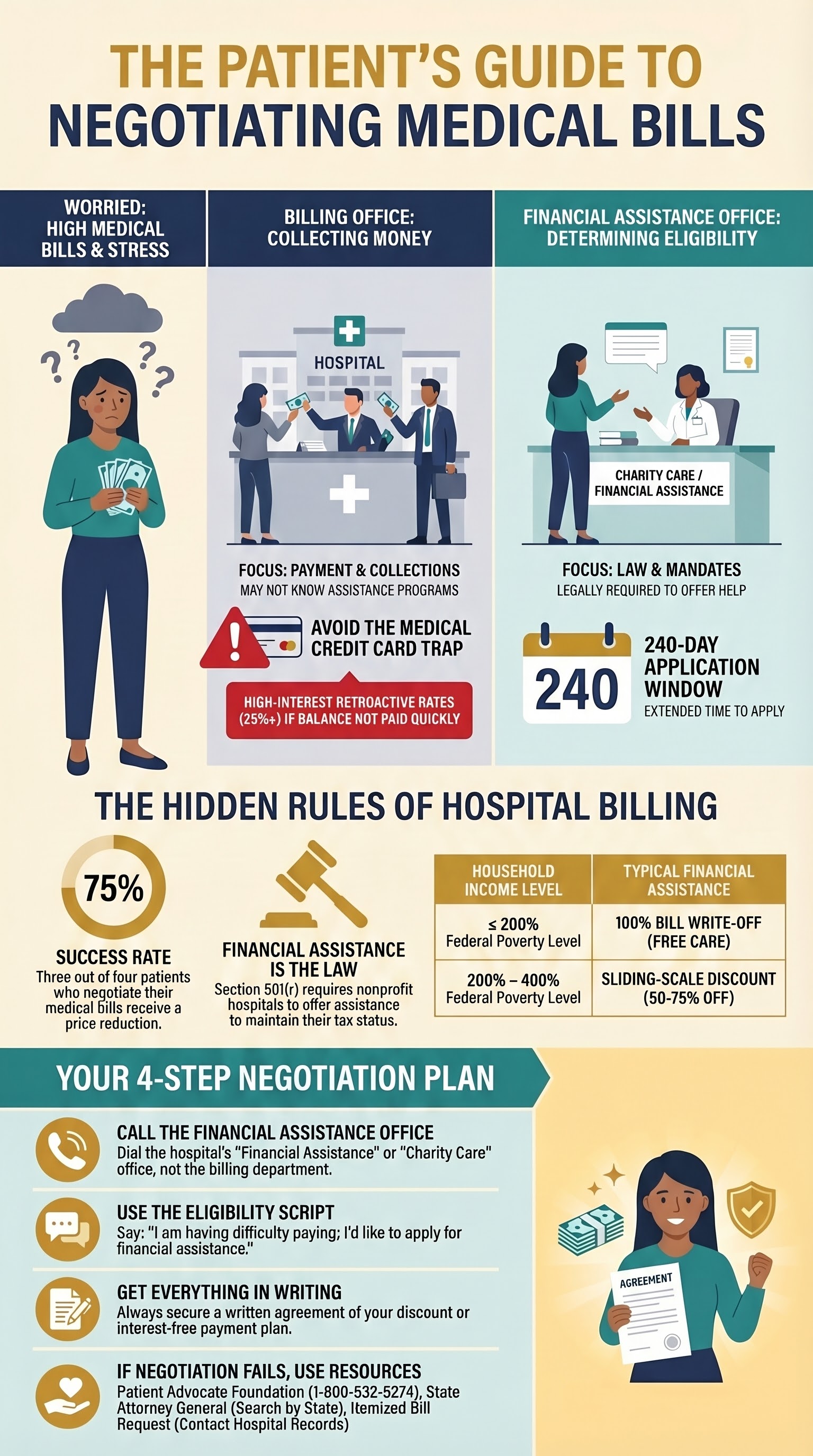
Priya just got a bill for $8,000. Her stomach dropped. Her first thought: “I guess I’ll put this on a credit card.” Wait. Before Priya does that—and before you do that—I want you both to know something most people don’t discover until they’re in deep: negotiating a medical bill is not something you ask for as a favor. It is something hospitals are legally required to offer. And it works about 75% of the time. Today we’re going to walk through exactly how to negotiate, and what to avoid.
Here’s the system. When you get a bill from a hospital, there are actually two departments: the billing department and the financial assistance office. They are different offices with different jobs. The billing department’s job is to collect money. The financial assistance office’s job is to determine if you qualify for free or discounted care. If the billing office says “no,” that doesn’t mean the financial assistance office will say no. They are separate conversations.
Most nonprofit hospitals are required by law to have a written financial assistance policy. That’s because of something called Section 501(r) of the tax code — it says: if you want to keep your nonprofit status and tax benefits, you must offer financial help to patients who can’t afford care.
Here’s how eligibility typically works. If your household income is at or below 200% of the federal poverty level — that’s about $52,000 for a family of four — you usually qualify for free care. The hospital writes off the entire bill. If your income is between 200% and 400% of the federal poverty level — that’s about $128,000 for a family of four — you usually qualify for a sliding-scale discount. Maybe they write off 50% or 75%.
How often does this actually work? A recent analysis found that about 62% of people who called their hospital about an unaffordable bill got either a payment plan or a price reduction. And 76% of people who wanted to negotiate said they got financial help or had their bill canceled.
Here’s why it works: hospitals aren’t actually charging full price to insured patients. When your insurance company negotiates with a hospital, they get a discount. They pay less than the full bill. Hospitals know that. They already accept lower payments from insurance companies. So when an uninsured or self-pay patient shows up with the full bill, that number is negotiable. The hospital knows they can’t collect it all.
The other reason it works is because of the law. Nonprofit hospitals must show that they provide community benefit to keep their tax status. They have to prove it. Charity care is part of that proof.
But here’s what people get wrong: they think the answer is a medical credit card. Maybe your hospital offers you CareCredit or Wells Fargo Health credit card “with zero interest for 12 months.” That sounds safe, right? It isn’t. Here’s the trap: if you don’t pay off the entire balance before the 12 months ends, interest — sometimes 25% or 27% APR — accrues on the entire original amount, not just what’s left. A $5,000 charge becomes $6,300 overnight. And then you can’t negotiate anymore, because the hospital already has its money.
Here’s your action this week. You’re going to make one phone call.
Step 1: Get your bill and identify the financial assistance number. Most hospital bills have a phone number for “financial assistance,” “patient financial services,” or “charity care.” If you can’t find it, call the main hospital number and ask to be transferred to the financial assistance office — not the billing office.
Step 2: Make the call. Here’s what Priya will say—and what you should say:
“Hi, I received a bill from your hospital, and I’d like to request an itemized bill. Can you send me an itemized statement showing exactly what I’m being charged for? I’d also like to speak with your financial assistance office about my eligibility.”
That’s it. You’re not asking for a favor. You’re asking for something you have the right to receive. An itemized bill shows you what you’re actually paying for—and gives Priya (and you) leverage in the next conversation.
Step 3: They will ask about your household income and family size. Be honest. They’ll compare it to the federal poverty level. If you’re below 400% FPL, you almost certainly qualify for something.
Step 4: If they offer you a payment plan, ask this question: “Is this interest-free, and for how long?”
If they say yes and show you it in writing, that’s good. Ask for the written agreement.
If they say they can’t help, here are your next moves:
What success looks like: You get either (1) a percentage of the bill written off, (2) an interest-free payment plan, or (3) both. You get it in writing.
What to avoid: Never offer to pay with a credit card during this conversation. Once you do, the hospital has its money and has no reason to negotiate further.
A medical bill is not your final responsibility. It is a starting point for negotiation. Most hospitals will negotiate. Call the financial assistance office, not the billing office. Ask about charity care and payment plans. Get it in writing. And avoid medical credit cards — they sound free but charge 25% interest if you slip up. You have time and options. Next lesson: Prior Authorization Decoded — why your insurance said “not so fast” to your medication or procedure.
Find your bill. Find the financial assistance phone number. Make the call with Priya’s script. Start with requesting an itemized bill. You have a right to see exactly what you’re being charged for. This 10-minute call puts you in a position to negotiate. The law backs you up. You have 240 days. Don’t wait.
Need help with medical paperwork? → Try our PA ToolkitCall your hospital’s billing department today and request an itemized bill — it’s your right and it’s free. Say: “Please send me a complete itemized bill with CPT codes for the services I received on [date].” You cannot negotiate what you cannot see.
Need help reviewing an itemized bill? Try the Bill Audit tool →Every claim in this lesson is sourced to peer-reviewed research, government guidance, or patient advocacy organizations. Here are the 12 sources.
This lesson is part of How Your Insurance Actually Works — an evidence-based course designed with clinical expertise by the AnchorWellPress Medical Team. This content is for informational purposes only and does not constitute medical advice, diagnosis, or treatment. Always consult your healthcare provider before making financial or medical decisions.