Module 2 · Lesson 2 of 3
The Hidden Costs
In-network facilities do not protect you from out-of-network bills. Learn where surprise charges hide and how to see them coming.
In-network facilities do not protect you from out-of-network bills. Learn where surprise charges hide and how to see them coming.
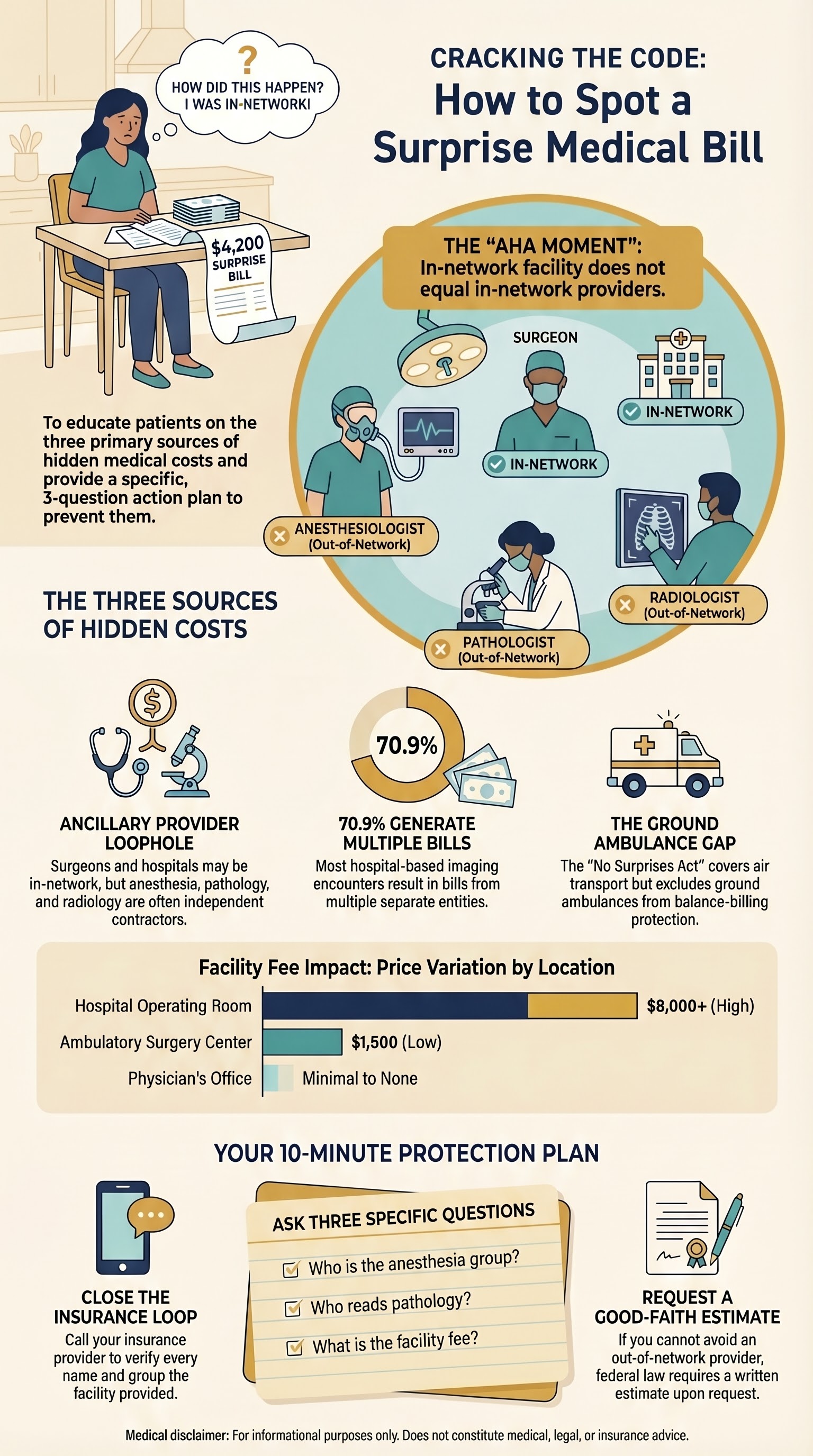
Maria chose an in-network hospital. She verified that her surgeon was in-network. She thought she was protected. But then the bill arrived: $4,200 from an anesthesiologist she didn’t choose and didn’t know was out-of-network. This is a surprise bill, and it happens to millions of patients every year. Maria’s bill is the story you need to know.
Hidden costs hide because they come from multiple independent sources: ancillary providers Maria didn’t meet, facility charges she wasn’t told about, and price variation she couldn’t predict. Understanding where these charges originate is the first step to protecting yourself. And the good news: Maria’s next procedure can be different. A ten-minute phone call tonight prevents the next surprise.
When Maria had surgery at a hospital, several independent providers were involved. Her surgeon—in-network. The hospital facility—in-network. But the anesthesiologist? The pathologist who reads her tissue samples? The radiologist who interprets her imaging? These are independent contractors. They may or may not have joined your insurance’s network. The hospital cannot force them to. So even though Maria chose an in-network facility, she was treated by an out-of-network ancillary provider—the anesthesiologist.
And when that happens, they bill you directly—often at much higher rates than in-network providers charge.
Hospitals charge a facility fee for using their operating room, equipment, and staff. Physician offices and surgery centers don’t. This is where the cost difference comes from. A laparoscopic appendectomy at a hospital might cost $8,000 in facility fees alone. The same procedure at an ambulatory surgery center might cost $1,500. The surgery itself is identical. The location makes the difference.
If an out-of-network provider charges more than your insurance plan is willing to pay, you receive the bill for the difference. This is called a balance bill. The No Surprises Act (NSA), which went into effect in 2022, protects you from balance bills in certain situations: emergency care, non-emergency care from out-of-network providers at in-network facilities, and air ambulances.
But ground ambulances are explicitly excluded. You can be charged $600 to $1,500 for a ground ambulance with no protection and no way to dispute it.
The same procedure costs wildly different amounts depending on the facility. Research shows variation of 400% or more—meaning the same surgical repair might cost $3,000 at one hospital and $12,000 at another, even when both are highly rated. Why? Geographic region, whether the hospital is public or private, and whether it operates as a safety-net facility all affect pricing. But hospital quality ratings do not. A five-star hospital does not necessarily charge more or less than a three-star hospital.
Hidden costs aren’t rare accidents. They’re systematic.
A study published in the Journal of the American College of Radiology analyzed 5.2 million outpatient imaging encounters. The finding: 70.9% of patients who received imaging at hospital-based facilities received bills from multiple entities—the radiologist, the facility, the anesthesiologist if sedation was used. This is routine, not an accident. Contrast agents and facility fees were billed separately in 55–71% of encounters.
When researchers analyzed contracted rates from 3,700 hospitals for hand surgery procedures, they found price variation of more than 400% for identical operations. A procedure might cost $2,000 at one facility and $9,000 at another. And here’s the concerning part: hospital quality ratings did not predict the price. Top-rated hospitals charged just as widely as lower-rated ones.
In an analysis of the top 50 pediatric orthopedic hospitals in the country, only 10% fully complied with CMS price transparency rules. Even among those 10%, the price for a single procedure ranged from $3,000 to $109,000—a 3,600% difference. Price variation persists even when hospitals are required to publicly report their prices.
When researchers looked at balance billing laws across seven states, they found neonatologists and other ancillary providers often remain out-of-network even at in-network hospitals. And when they do, they charge 2–3 times more than in-network rates. The providers have little incentive to join networks because the Independent Dispute Resolution process—the mechanism designed to protect patients—has fee caps that make it financially unviable for them to dispute most claims.
Ground ambulance services are not covered by the No Surprises Act. Ground ambulance costs average $600–$1,200 for non-emergency transport and can reach $1,500 or more for long-distance transfers. Patients are frequently surprised by balance bills because they don’t know ground ambulances fall outside consumer protections.
According to the Commonwealth Fund, 26% of Americans carry medical debt. Surprise bills from ancillary providers and facility fees are among the leading causes. The surprise bills that hurt patients most are from anesthesiologists, radiologists, and pathologists—exactly the providers who work inside your in-network facility but remain out-of-network.
Before scheduling surgery or a major procedure, make one phone call. Call your in-network facility and ask: “Who are the anesthesiologists? Are they in-network with my plan? Who reads pathology slides? Who does the imaging? What is your facility fee?” Write down every name and status.
Then call your insurance plan member services (number on the back of your card) and verify whether each ancillary provider is in-network.
Ask the surgery center if they have in-network alternatives. Many hospitals have multiple anesthesia groups. You may have a choice.
If you cannot avoid an out-of-network provider, ask for an estimate in writing before the procedure. Get it in writing. The law now requires providers to give you a good faith estimate if you ask for one.
First: Request an itemized bill from the provider. Do not pay immediately. You have 120 days to dispute.
Second: Check the bill against your pre-procedure estimate. If it differs significantly, contact your insurance plan’s member services and request an independent dispute resolution (IDR). The IDR is free for you. Your plan and the provider will present their case to a neutral third party, who makes a final decision. You don’t have to attend—the plan handles it.
SHIP (State Health Insurance Assistance Program): 1–800–839–2675 or https://www.shiphelp.org
Patient Advocate Foundation: 1–800–532–5274 or https://www.patientadvocate.org
Success looks like this: You call your facility, identify which providers are out-of-network, and request in-network alternatives before your procedure. If you can’t find them, you get an estimate in writing and understand exactly what you may owe.
Failure looks like this: You receive a surprise bill and freeze. But even then, you still have a move. Call your plan’s member services and request IDR. You have 120 days.
Tomorrow, 10 minutes. One phone call. Three questions. If you have a procedure scheduled in the next 90 days, call your facility. Ask: (1) “Who is the anesthesia group?” (2) “Who reads pathology?” (3) “What is the facility fee?” Write down every name and number. Then call your plan’s member services line (back of your card) and verify each name. This takes 10 minutes and can save you thousands—Maria’s story proves it.
Need help understanding your EOB? → Try our EOB Explainer toolAll claims in this lesson are sourced from government and peer-reviewed research:
Before your next scheduled procedure, call the facility and ask: “Is every provider involved — anesthesiologist, radiologist, pathologist — in-network with my insurance?” Then ask for a written Good Faith Estimate. The No Surprises Act gives you the right to both.
Already have a surprise bill? Try the Bill Audit tool →This lesson is part of How Your Insurance Actually Works—an evidence-based course designed with clinical expertise by the AnchorWellPress Medical Team. This content is for educational purposes only and does not constitute medical advice, diagnosis, or treatment. Always consult your healthcare provider.